Properties of addition and multiplication
If $x,\, y \in \mathbb{Q}$ and $z,\, t \in \mathbb{I}$:
| Sum | Product | |
|---|---|---|
| $x,\, y \in \mathbb{Q}$ | $x + y \in \mathbb{Q}$ | $x \cdot y \in \mathbb{Q}$ |
| $x \in \mathbb{Q}$, $z \in \mathbb{I}$ | $x + z \in \mathbb{I}$ | $x \cdot z \in \mathbb{I}$ (if $x \neq 0$) |
| $z,\, t \in \mathbb{I}$ | It depends | It depends |
Why “it depends”?
$\sqrt{2} \cdot \sqrt{2} = 2$, which is rational; but $\sqrt{2} \cdot \sqrt{3} = \sqrt{6}$, which is irrational.
$\sqrt{2} + \left(-\sqrt{2}\right) = 0$, which is rational; but $\sqrt{2} + \sqrt{3}$ is irrational.
The problem of the two ants in love
The problem
Two ants in love sit on the same vertex of a square with 2 m sides. Both travel at the same speed: one goes round the square along its sides and the other crosses it along the diagonal. Will they ever meet again at exactly the same point of the square?
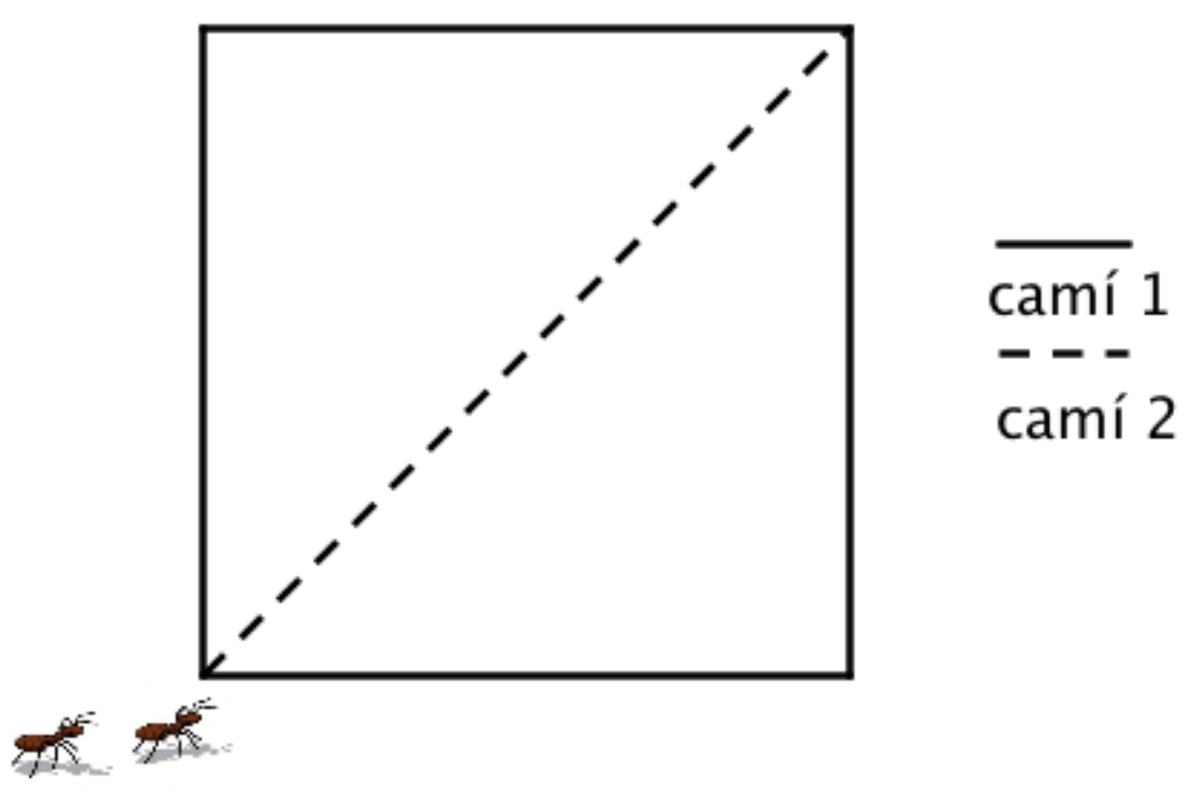
See the solution
The diagonal of the square
$d^2 = 2^2 + 2^2 = 8$, and so $d = \sqrt{8} = 2\sqrt{2} \approx 2.83$ m.
The two distances
The ant along the sides: $4x \in \mathbb{Q}$
The ant along the diagonal: $\sqrt{8} \cdot y \in \mathbb{I}$
The ant along the sides has always covered a rational number of metres: each side is $2$. The one along the diagonal has always covered a multiple of $\sqrt{8}$, which is irrational. For them to meet, the two distances would have to be equal — and a rational is never equal to an irrational.
Conclusion
Mathematically, the two ants can never meet again.