Problem 1 · Two parallel rectangles
The relation $AE^{2}+CG^{2} = BF^{2}+DH^{2}$ between opposite corners.
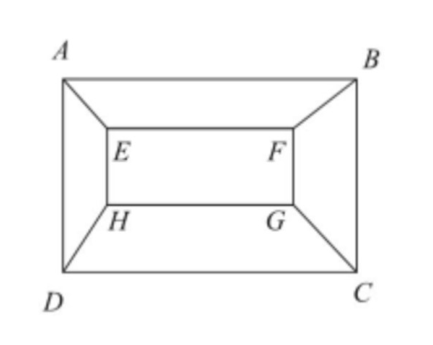
Integer answer, at most 4 digits$ABCD$ and $EFGH$ are two rectangles with parallel sides. If $AE = 15$, $BF = 27$ and $CG = 25$, how long is $DH$?
Copa Cangur · SCM
Medium
Closed answer
Reasoned solution
Key idea: set up coordinates: each corner-to-corner segment has a horizontal and a vertical component, and opposite pairs share components.
With $A=(0,0)$, $B=(W,0)$, $C=(W,H)$, $D=(0,H)$ and inner rectangle $[x_1,x_2]\times[y_1,y_2]$:
$$AE^{2}+CG^{2} = \left(x_1^{2}+y_1^{2}\right)+\left((W-x_2)^{2}+(H-y_2)^{2}\right) = BF^{2}+DH^{2},$$
because $BF^{2} = (W-x_2)^{2}+y_1^{2}$ and $DH^{2} = x_1^{2}+(H-y_2)^{2}$ split exactly the same four squares. Hence:
$$DH^{2} = 15^{2} + 25^{2} - 27^{2} = 225 + 625 - 729 = 121 \;\Longrightarrow\; DH = 11.$$
Answer: 11